- HubPages»
- Travel and Places»
- Visiting Africa»
- Travel to Southern Africa
Historical Buildings in Cape Town: Koopmans-de Wet House

A family connection
Cape Town is full of historical buildings, and since my family were connected to the city for many years, many of these buildings have personal interest to me, including this beautiful old house.
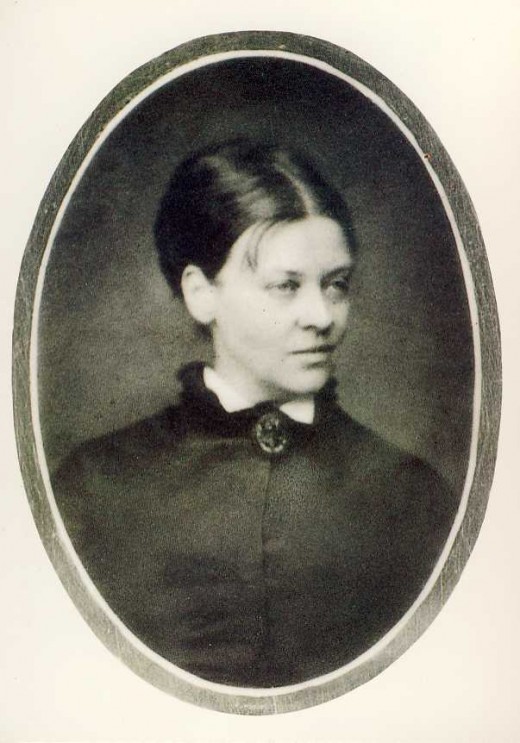
My great-great-grandfather Dr William Robertson moved, in 1872, from Swellendam to Cape Town to minister in the Grootte Kerk in Adderley Street (known until 1849 as the Heerengracht), where he ministered until his death in 1879. During that time he and his family lived in a house in Strand Street, at number 74.
After his death, Robertson's second wife Aletta Matilda lived in the house for the next 29 years of her life.
“She kept open house, and was always pleased to see any of the members of the Robertson and Blackall (widow Robertson had been married to General Blackall of the Indian Army and married Robertson after the General's death) families, as well as her Cape Town friends,” wrote Isobel Robertson, in her biography of the Robertson family called From Aberdeen to Overberg.
“Among these were the Koopman de Wets – Lily Huskisson (a granddaughter of William Robertson) told her children that she was frequently in and out of the house which is now a museum in Strand Street.”
The story of the house
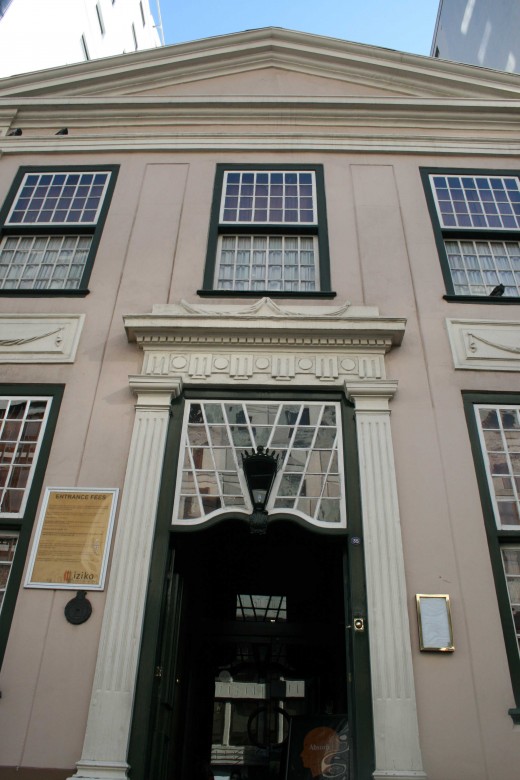
The first house on the stand was probably built by a Hollander by the name of Reijnier Smedinga, who was an official silver assayer at the Cape, in the early years of the 18th Century.
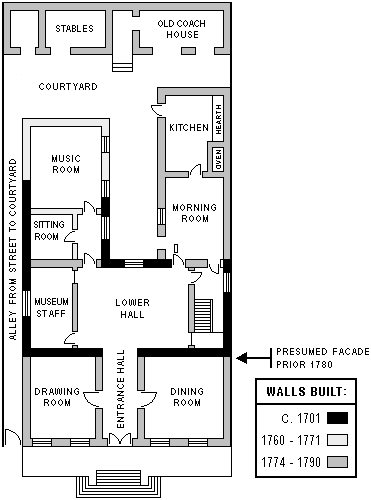
The owner of the house who had the most influence on its present appearance as one Pieter Malet from Amsterdam, who acquired it in 1771. He enlarged the house considerably to accommodate his large family of 16 children and numerous slaves and servants.
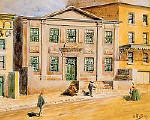
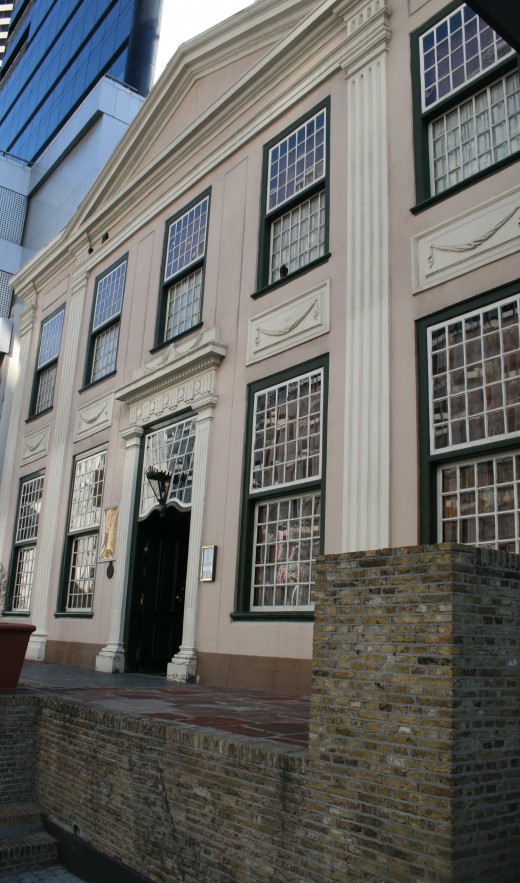
Malet added the imposing facade in around 1790. There is still speculation about who designed the facade, but many believe it could have been either the French-born Louis Michel Thibault or the German-born sculptor Anton Anreith, both of whom worked extensively in the Cape at that time.
Whoever it was did a fine job of it. On the official website of the Iziko Museums of Cape Town, of which Koopmans-de Wet house is one, describes the facade in words better than I could:
“The facade of the house possibly dates from 1790 and is characterised by its four fluted pilasters, some of which are made of wood, others of plaster. The pediment spans three windows instead of the usual one. An architrave crowns the entrance and a triglyph and metope frieze lies directly underneath. There is a lantern in the fanlight of the entrance door. A candle in the lantern was lit every evening as soon as it grew dark. Rectangular panels with plaster garlands fill the spaces between the windows of the ground floor and those of the first floor.”
The last private person to live in the house was Maria Koopmans de Wet, the person visited by the Robertsons. On her death the house was sold to the nation and opened its doors as a museum in 1914.
The museum
It is the oldest house museum in South Africa and regularly hosts exhibitions and lunchtime musical entertainments, notable by the popular Ace Quartet, made up of Gabriele von Durckheim (flute), Este Pienaar (violin), Annemi van der Merwe (viola) and Ariella Caira (cello), who play a pot-pourri of well-known and light classical music - including favourites by Mozart and Vivaldi - interspersed with contemporary tunes.
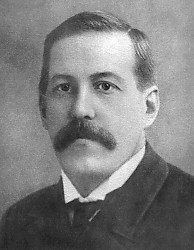
The museum was put on the map, as it were, by the enthusiastic efforts of Dr William Frederick Purcell (1866-1919) a zoologist who joined the South African Museum in 1896. He had received his D.Phil in Berlin in 1895.
A plaque in the entrance hall of the museum commemorates Dr Purcell's efforts.